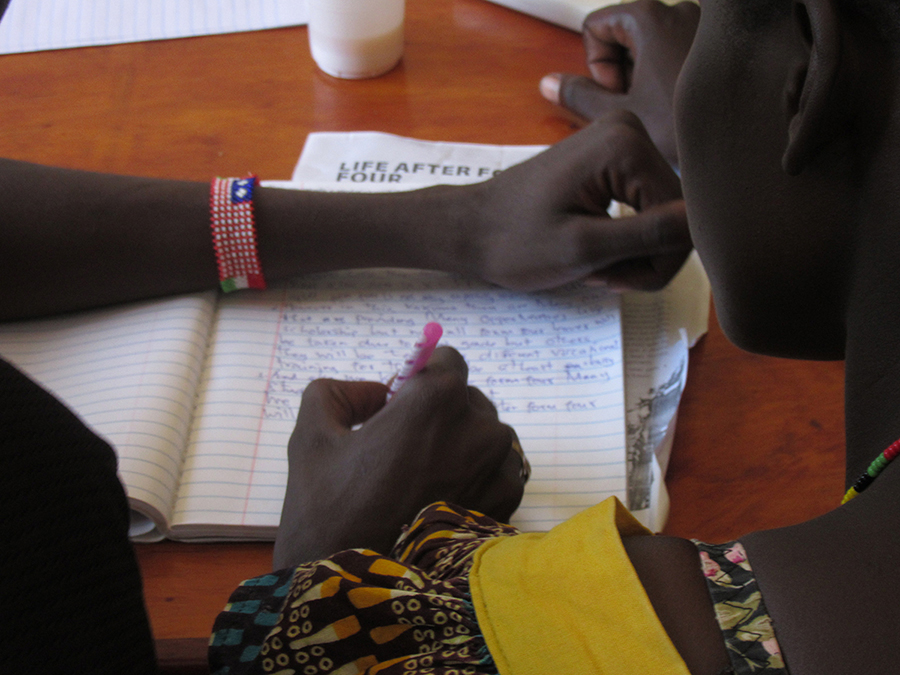
Research has demonstrated the significant role of schools in shaping young people’s evolving sense of civic identity, agency, and belonging. Yet we know little about the educational experiences of refugee youth whose opportunities for participation are constrained by encampment and exclusionary citizenship policies. Drawing on participatory and ethnographic methods, this research employs the framework of youth citizenship as a lens into educational interactions in a refugee camp setting. Through participant observation in classrooms and communities, this study documents the educational trajectories of a youth cohort over three years as they develop their future aspirations amidst political turmoil and protracted uncertainty. The participatory dimension of this work explores the ways in which refugee youth leverage their voice to advocate for educational change. As unprecedented numbers of displaced youth migrate and integrate into stable and weak democracies across the globe, it is crucial to better understand how education systems contribute to young people’s prospects for social mobility and belonging. Findings resulting from this study can deepen our understanding of how schools convey, constrain, and create youth civic pathways, so that we can better prepare youth for their roles as citizens in the present and in preparation for their unknowable futures.
Supported by NAEd/ Spencer Foundation, University of Michigan Office of Research, and U-M School of Education. In collaboration with the Kakuma Youth Research Group.
Meet Almarat. Native to South Sudan, Almaret arrived at Kenya’s Kakuma Refugee Camp in 2006. The educational challenges he faced in the camp were immense, including mastering a new language and overcoming the scarcity of educational resources. Despite financial setbacks that forced him to temporarily halt his schooling, Almarat’s determination secured him a scholarship, allowing him to continue his studies. His resilience and tenacity serve as a model for aspiring business professionals. Almarat’s message is clear: patience is key. Watch this video to hear him reflect on his educational journey.
Meet Augustin. Augustin is a South Sudanese national who was born and raised in Kakuma Refugee Camp. The challenges he encountered in primary school, such as overcrowding and limited resources, did not deter his pursuit of education. After completing school in 2016, Augustin attended a film courses in Kenya, where he built his skills and grew in confidence. Currently, he is actively involved in various film-related projects. Augustin’s advice to other youth emphasizes making the most of their time and skills, highlighting the shortness of life. Watch his video to listen to his powerful message.
Meet Biliny. Born and raised in Kakuma, Biliny’s journey is a testament to the power of dreams. The challenges she faced, from lack of school materials to the distressing absence of sanitary products, could have easily deterred her. Yet she rose above these adversities, even using her experiences to become an advocate for change. Today, Biliny is not only a promising international model, she’s an inspiration to girls and young women in Kakuma and beyond. Her story is a powerful reminder that with determination and self-belief, one can do anything. Watch Biliny’s video to hear her inspiring story.
Meet Fabrice. Fabrice is a Congolese refugee who began his education in Kakuma Refugee Camp in 2012. As the first born, he balanced school with household duties, often waking up early to study and complete chores. He chose to attend a private school, believing it offered a better education than the public schools in the camp. However, this came with financial challenges, leading him to work to support his family and pay for his education. The lack of resources, including textbooks, further complicated his studies. Despite these hurdles, Fabrice completed high school in 2022. He then pursued his passion for music while also teaching chemistry and math. Fabrice’s story highlights the determination of refugee students. Watch this video to hear him reflect on his educational journey.
Meet Fario. Fario, a Somali residing in Kakuma Refugee Camp, began her primary education in 2008 and later joined Kakuma Refugee Secondary School in 2016, completing her studies in 2019. The challenges she encountered during her educational journey were significant. In primary school, she faced a shortage of teachers, classrooms, and learning materials. The challenges persisted in secondary school, where the long distance between her home and school often made her late. She also struggled with learning difficulties. Despite these obstacles, Fario persevered and is currently working as a Health Promoter. Her advice to the youth in the camp is to actively seek opportunities to further their skills and education. Watch this video to hear her reflect on her educational journey.
Meet Gatwech. Gatwech is a South Sudanese national, residing in Kenya’s Kakuma Refugee Camp since 2003. Despite the challenges of displacement, he never wavered in pursuing his passion. He adeptly navigated limited resources and educational barriers during his primary years, later attending a technical institute to develop his skills in Information and Communications Technology (ICT) and then attending college to develop skills in graphic and web design. Although financial hardship interrupted his studies, Gatwech’s determination remains strong, serving as an inspiration to fellow refugee youth. Watch his video to hear him reflect on his educational journey.
Meet Manahil. Arriving at Kakuma Refugee Camp in 2012, Manahil faced significant challenges during her 13 years there. The overcrowded schools fostered an environment where lessons weren’t taken seriously, hindering her learning experience. Furthermore, she encountered community pressure and gender biases that suggested girls could not excel academically, which at times affected her self-worth. Unable to continue her formal education due to her grades, Manahil chose a different path. She joined Humanity Hands, a community-based organization in Kakuma focused on giving back. Despite the setbacks, Manahil remains positive and encourages other youth not to give up on their dreams, even when faced with challenges or unmet expectations.
Meet Mary. Born in Ethiopia, Mary arrived in Kakuma Refugee Camp in 2009. Mary faced significant cultural barriers in her pursuit of education. The community she came from discouraged girls from attending school, and even though her parents supported her, she still felt the pressure. Despite this, Mary worked hard and earned a scholarship to attend secondary school. However, she encountered further challenges adapting to the diverse cultural environment at the school. The COVID-19 pandemic disrupted her studies, leading to a disappointing performance. Undeterred, Mary turned to volunteering and pursued studies at a technical institute. She also nurtured her skills in photography and translation. Watch her video to discover how she forged her own path.
Meet Nancy Pony. Nancy Pony, a South Sudanese refugee born and raised in Kakuma Refugee Camp, overcame numerous educational challenges to achieve success. Despite overcrowded classrooms and learning difficulties, she excelled in primary school and earned a scholarship to attend secondary school, where she thrived. While initial setbacks prevented her from attending college or finding work, Nancy’s perseverance led her to pursue technical training in computers and Information and Communications Technology (ICT), which ultimately secured her a job. Her inspiring story serves as a reminder of the power of hope and resilience in fulfilling one’s goals Watch this video to hear her reflect on her educational journey.
Meet Nyakwar Ngatwech. Nyakwar Ngatwech, a South Sudanese living in Kakuma Refugee Camp since 2014, faced gender bias and financial hurdles in her pursuit of education. However, her curious nature urged her forward. After high school, she discovered a passion for computers through a six-month course, sparking her interest in the field of technology. She continued to expand her skills by taking additional courses in information technology, programming, and UX design. Nyakwar’s advice to other youth in the camp is to be proactive and seize opportunities, regardless of their background or grades. She encourages girls in particular to embrace their curiosity and defy societal expectations.
Meet Nhiel Deng. Nhiel Deng, who grew up in Kakuma Refugee Camp, faced the unique challenges of navigating education as an unaccompanied minor. The separation from family forced him to become self-reliant at a young age. Despite the limited opportunities for higher education and employment in the camp, Nhiel Deng was determined to pursue his dreams. He enrolled in a media training program to continue learning new skills. His dedication and talent earned him a prestigious scholarship for study in Canada. Currently in a Global Studies and Communications program, Nhiel Deng’s journey exemplifies resilience and the pursuit of knowledge amidst adversity and separation.
Meet Pall. Pall’s educational journey was not without its challenges. In primary school, he faced the difficulties of long distances between his home and school, overcrowded classrooms, and the harsh Kakuma heat, all of which impacted his ability to concentrate and learn. In high school, limited instructional time for certain subjects made it challenging to grasp the material fully. Despite these obstacles, Pall’s commitment to education and community service shines through. After high school, he dedicated his time to volunteer work and sports activities. Currently, he manages his role as a supervisor at a community center while pursuing higher education. His story serves as an inspiration to others, highlighting the importance of passion in overcoming adversity.
Meet Richard. Richard’s educational journey in Kakuma Refugee Camp was fraught with challenges. Despite the difficulties in obtaining his primary school certificate, he persevered with the help of others. He went on to excel in high school, becoming one of the 150 students in his class to pass the national examinations. However, his high school experience was marked by overcrowded classrooms and a lack of teachers for science for an entire year, hindering his progress in that subject. After high school, Richard channeled his experiences into community service, working as a health promoter and later as a computer teacher. His passion for computers and empowering others led him to found “Code With Us,” a school dedicated to equipping women and youth with technological skills. Richard’s innovative spirit and story speaks to the transformative power of education.
Videos recorded by Kakuma Media Productions/ Story Matters Entertainment, in collaboration with Kakuma Youth Opportunities for Lifelong Learning. Special thanks to Aysha Jerald and Naviedya Parakkal for their support on this project. Funding was generously provided by the University of Michigan Office of Research and the African Studies Center.
 Michelle J. Bellino